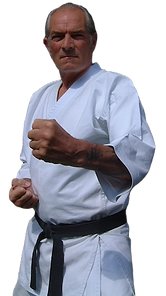
The Life and Legacy of Peter Spanton
Peter Spanton (1943–2020) was a pioneering figure in British karate, renowned as one of the first generation of British karateka and a key influencer in the development of Wado-ryu in the UK. He founded the Higashi Karate Kai organization, achieved the rank of 9th Dan, and contributed significantly to karate administration, refereeing, and innovation through technology. Known for his exceptional flexibility, kicking ability, and emphasis on traditional kata applications, Peter trained and inspired numerous prominent karate practitioners while maintaining a lifelong commitment to the martial art's roots over competitive sports karate.
Early Life
Born in 1943 in Bow, East London, Peter grew up in a working-class environment. He left school at the age of 16 in 1959 to work as a grocer’s apprentice before laboring alongside his father. In 1961, he joined the Merchant Navy, where he served until 1965, traveling the world and building physical fitness through the demands of seafaring life. This period abroad exposed him to diverse cultures and honed his discipline, setting the foundation for his later pursuits in martial arts.
Beginnings in Karate
Peter's entry into karate came in February 1965, shortly after leaving the Navy at age 22. Intrigued by a newspaper article on the subject and initially considering judo, he contacted the British Judo Society, which directed him to Len Palmer. Palmer informed him of the impending arrival of Japanese instructor Tatsuo Suzuki (then 6th Dan) in the UK. Peter began training under Suzuki at the Honbu Dojo in Clapham, South London, as part of the All-Britain Karate-Do Association (ABKA). He was immediately captivated, describing himself as "hooked" from the first session.
Training was rigorous, focusing on repetitive basics like punching and kicking, with classes of 20–40 adults, mostly men, and no children involved. Peter trained under additional Japanese instructors, including Teruo Kono, Masafumi Shiomitsu, and Toru Takamizawa, three times a week at the dojo plus independently. He progressed quickly, starting sparring after six months as a white belt and facing Suzuki himself, who targeted his tall frame with shin and front kicks—experiences Peter embraced as valuable learning opportunities.
As a brown belt, he opened his first clubs in East London, including Custom House and Forest Gate (the latter relocating to a community center after he earned his black belt). In December 1966, a mere 3 months after being promoted to 2nd kyu (brown belt), Suzuki unexpectedly promoted him to 1st Dan (Shodan), making him one of the first Englishmen graded to black belt in Wado-ryu by Suzuki. At this rank, his knowledge encompassed the five Pinan katas, Kushanku, and Naihanchi, with a more limited set of techniques than modern standards.
Competitive Achievements and Transition
Peter's competitive career was brief but notable. In 1966, as a green belt, he represented Britain in its first Wado-ryu international match against France and won a bronze medal at the European Karate Championships in Paris, defeating French champion Dominique Valera in the semi-finals but withdrawing from the final due to a broken wrist. This made him England's first international medal winner in karate. He competed until around 1968, finding early tournaments more realistic and less restricted than modern ones, without protective gear or excessive rules. He then shifted focus to the martial aspects, attending a WUKO Referees Course with Tommy Morris and Danny Connor.
In the 1980s, Peter became a highly respected referee, serving as Chief Referee for England and a world-level kumite and kata judge for the World Union of Karate-Do Organizations (WUKO) and the European Karate Union—the first European WUKO kata judge. Japanese examiners once noted he should compete in kata rather than judge it. He officiated at several WUKO World Championships.
Organizations and Contributions
Amid internal politics in 1967, when Japanese instructors left the ABKA, Peter was a key figure alongside Len Palmer, Ticky Donovan, and Dave Mitchell, who helped to reshape the ABKA as the British Karate Association (BKA). As a senior grade, he taught nationwide.
In 1968 (formalized in 1972), he co-founded the Higashi Karate Kai (HKK), with “Higashi” meaning "East" to honour both his original East London club and the eastern origins of karate, and featuring a logo inspired by his personal dragon tattoo which he acquired while travelling with the Merchant Navy. It split from the BKA in 1972–1973 with 27 clubs and grew to over 60 across England, with affiliates in Wales, Ireland, Spain, and Australia, boasting around 1,800 members by the early 2000s. HKK remained rooted in Wado-ryu but was sometimes called Higashi-ryu by seniors.
Peter co-founded the English Karate Governing Body (EKGB) in 1980 with Ticky Donovan and John Smith, serving on its Executive Board, and sat on the British Karate Control Commission (BKCC). He was among the first professional karate instructors in the UK and taught influential figures like Vic Charles, who credited him for stretching techniques. Alongside peers like Steve Arneil, Andy Sherry, Terry O’Neill, and Ticky Donovan, he was at the forefront of British karate.
An innovator, Peter pioneered computer applications in karate starting with the Sinclair ZX series, creating the first membership register and a tournament draw system adopted internationally, including in Japan. He viewed karate and computing as complementary, noting, "The Karate conditions my body and the computer keeps my brain sharp."
Peter emphasized kata bunkai (applications) practiced realistically and created four original Higashi katas—Higashi Sho, Higashi Ni, Higashi San, and Higashi Yon—to supplement Wado-ryu's forms while adhering to its principles. He produced a Pinan kata video for VMA and modeled in David Mitchell’s books.
His ranks progressed to 4th Dan in 1974 (graded by panel consisting of Suzuki, Kono, and Takamizawa), 8th Dan in 2004 (by HKK and EKGB), and 9th Dan in 2015 – his 50th year in karate training. He also served as Chief Instructor to Derek Ridgway of Kazoku Kai International for many years, influencing that organization.
Personal Life and Views
Peter had a younger brother, Colin, who trained under him and became a black belt in the 1970s. He valued tradition, lamenting how "tournament seems to have taken over and we’ve lost a lot of our tradition," and stressed knowing one's martial roots. Even in his 70s, he conducted monthly kata courses, regular Dan gradings, and regional teaching, adapting to physical limits while remaining active—such as the annual trip to Snowdonia to run a 5 day outdoor training course in Snowdonia, known affectionately to attendees as “Ogwen” after the caravan park that played host to the event and the river that new attendees were ceremoniously dunked in as a rite of passage.
Peter’s Legacy
Peter passed away on November 23, 2020, at the age of 77 following a brief illness. His legacy endures through HKK's success (topping medal tables in tournaments like the 2002 BKF and EKGB events), the instructors he mentored, and his innovations that bridged traditional karate with modern tools. He is remembered as a dedicated practitioner who rejected retirement, embodying the spirit of lifelong martial arts pursuit.
________________________________
Sources
The biography of Peter Spanton was compiled primarily from publicly available online sources dedicated to karate history, Wado-ryu lineages, and tributes to British karate pioneers. These include detailed profiles, interviews, association websites, and historical accounts from Higashi Karate Kai affiliates.
Here is a list of the key sources used (with direct links where available for reference):
1. **Finding Karate profile on Peter Spanton**
- http://findingkarate.com/wordpress/profile-peter-spanton
- A comprehensive biographical overview covering his early life, training under Tatsuo Suzuki, competitive achievements, organizational roles, innovations (e.g., computer programs), kata contributions, ranks, and death in 2020. This was a primary source for many chronological and factual details.
2. **Higashi Karate Kai official website – About page**
- https://www.higashi.org.uk/about
- Provides official details on his founding of Higashi Karate Kai, training start in 1965, grading history (Shodan in 1966, Kudan in 2015), and succession after his passing. It also links to a 2003 interview.
3. **2003 Interview with Peter Spanton (hosted on steve-rowe.com and referenced across sites)**
- https://steve-rowe.com/2015/10/29/peter-spanton-interview-2003
- An in-depth personal interview covering his beginnings, dojo experiences, formation of Higashi, views on competition/tradition, computer innovations, and respect for peers. This supplied many direct quotes and personal insights.
4. **Kazoku Kai International – Peter Spanton instructor profile and interview**
- http://www.kazokukai.com/instructors/peter-spanton
- Features a detailed interview (conducted by Derek Ridgway) discussing his training history, Higashi development, kata creation, refereeing, and opinions on modern karate. It includes context on his long-term contributions and affiliations.
5. **Luton Higashi Karate – Sensei Peter Spanton page**
- https://luton-karate.co.uk/about/sensei-peter-spanton
- Offers a focused bio on his early achievements (e.g., first international medal), refereeing reputation, impartiality, and legacy within Higashi. It includes anecdotes about training challenges and Japanese examiners' praise.
6. **Cardiff Higashi Karate Club – History page**
- https://cardiffhigashi.wixsite.com/cfhk/history
- Provides club-level history tied to Spanton, including East London origins, federation growth, and affiliations (e.g., Wales, Ireland, Australia).
7. **Higashi Karate Kai Wales – Tribute post**
- http://hkkw.co.uk/sample-post-with-carousel
- A memorial announcement confirming his death on November 23, 2020, and highlighting his pioneer status and global expansion of Higashi.
8. **Additional supporting references**
- Higashi Karate Kai home page (https://www.higashi.org.uk/) – General federation history and tribute links.
- Facebook tribute page (Peter Spanton – HKK Karate Tribute Page) – Community tributes and photos confirming legacy.
- Forum discussions (e.g., e-budo.com threads on senior British karateka) – Contextual mentions of his rank progression and peers for cross-verification.